Metaphorical Processing: What Current Science & Particle Physics Ignores
One of the greatest things about doing independent research is that I stopped caring a few years ago about what any person would say about how I work. Dropping the performance saves my life. Nuanced thinking saves my life. Having an open mind and not believing everything I see online saves my life. Avoiding constant literal processing saves my life. Metaphorical processing is my life.
(Before we begin) How I define “god”: infinite cosmic consciousness (intelligence), omnipresent, omnipotent, omniscient, unbounded, formless, and nonlinear
What do I mean by processing?
Thinking
Translating/interpreting
Communicating
Listening
Literal Processing vs. Metaphorical Processing
First, let’s define literal: clear definitions, nothing left to interpretation. We see literal processing so often everyday that we don’t register it as so. For example, 2 + 2 = 4, red light = stop, green light = go, etc.
What does processing metaphorically look like?
Thinking in parables
Being open to multiple interpretations
Applying foundational principles in two seemingly unfamiliar things in material reality and seeing symmetry.
Perhaps one could argue it’s a natural way of finding unity in all.
Metaphor definition directly from Merriam-Webster: “a figure of speech in which a word or phrase literally denoting one kind of object or idea is used in place of another to suggest a likeness or analogy between them (as in swimming in paperwork)”
In my Mahashivratri Musings blog post, I discussed why divine entities speak in metaphors/riddles. At first, it seems like an annoying movie bit, but it’s out of deep respect for our free will to be able to interpret which reality we want to select out of the concept presented to us. All interpretations are considered “correct”, not in the sense that one is morally better than the other, but it is “good” simply because it exists. Being allowed to exist is the divine’s way of giving love via awareness to an idea.
Benefits of processing metaphorically:
deeper richness in consciousness
ethical level of symmetry with the universe, acknowledging some answers will never be “known”, just black-boxed away
greater expansion of cognitive ability (higher intelligence)
or are we inadvertently linking cognitive ability to consciousness ability?
because then if consciousness expands, then we go beyond cognition
you could argue that consciousness awakens in all parts of our being, considering consciousness is fundamental
Science was meant for the literal. Religion was (not sure if I should say “supposed to” because perhaps the intention was this?) supposed to be for the metaphorical. The problem is, we started forcing literal interpretation on something that could never be literal, and we intertwined it with government and policy, causing great societal friction.
The inspiration for this thinking was a multi-faceted one, but one woman on TikTok helped catalyze this thought process a while back when she critiqued the way spiritual people looked at quantum physics with a metaphorical interpretation of a science that was meant only for things at extremely small scales, so how could they apply literally to large scales?
I understand the argument for literal thinking, and in no way am I suggesting abandoning it; I am proposing more complete thinking, deeper investigation, sovereignty in critical thinking, and new ways (or resurfacing ancient ways) of knowing to advance our civilization. The argument, however, for literal processing is to be absolutely logical so that there’s order and harmony. Let’s challenge that: your “logic” is still derived from emotional reasoning.
Example: driving logic (strategy, maneuvering, speed, human interaction like road rage or calm approach, etc) is driven (no pun intended!) by the emotional reasoning of not wanting to die and the emotional reasoning of not wanting to die is because you enjoy your life, enjoyment: another emotion.
A lot of the condescending feedback on greenfield theories of the universe comes from pointing out what isn’t experimentally verifiable, directly testable, perfectly curated and instead on what’s metaphorical or philosophical, which, in my observation of reality, doesn’t make sense, considering that
(1) metaphorical/symbolic processing is the natural next step
(2) actually requires more advanced and diverse intelligences applied
Revisiting levels of Vak (articulation/communication) for our upcoming rainbow metaphor: Para (transcendental sound), Pashyanti, Madhyama, and Vaikhari (expressed speech), more explanation in my older blog post: Mahashivratri Musings

What a gorgeous rainbow. Consider how a rainbow even comes into observable perception for the human eye. It slowly fades in. The rain and sunlight highlight the prismatic nature of reality always present with us. Consider where a rainbow starts and ends from the angle of red to purple and also from left arc to right arc (we, of course, know that rainbows in their purest forms are circles). It fades and blends in. Boundaries become questionable.
Dynamic elements: water droplet density, sunlight intensity, viewing angle
The sunlight refracting and reflecting in water droplets paired with the angle of observation creates the image of a rainbow, making rainbows a relational phenomena rather than fixed objects.
White light contains a hidden spectrum that only appears under certain conditions. Consciousness or reality might contain structures that only appear under certain ways of perceiving.

Gorgeous striking contrast between the darker storm clouds and the highlighted vibrance of my good friend, Mr. Bo
To move from levels of Vak, I couldn’t even really conceive what it would be like to be in Pashyanti. I figured it was more of an experiential thing that couldn’t be put into words, but if I look at it like a rainbow with the 7 fundamental colors, and if I were to zoom into each color, I’d see a rainbow of its own right within each layer (ex: shades of red within the red layer), and that layer would have its own, and so on. The rainbow demonstrates that what appears as discrete colors is actually a continuous spectrum.
If we’re wanting to move from Vaikhari —> Madhyama —> Pashyanti, meaning move backwards from expressed speech to the cosmic synesthesia/symbolic realm, we may apply those rainbow principles (infinite recursion) to levels of Vak, too. Madhyama, inner inaudible speech or thoughts, is the most etheric accessible layer to us, and also, it isn’t a solid block of being all the way through. Madhyama could have levels of its own Vak, too. Going from the most transcendental inner speech (Para Madhyama) to the most literal inner speech (Vaikhari Madhyama). Accessing Pashyanti would mean accessing crossing the border from Madhyama to get to Pashyanti, and the best, most accessible way for that is to encourage our thoughts to be as transcendental as possible.
Current western science has done an excellent job of explaining all of the material world. After all, it is natural for cosmological systems (you and I are also part of that) to self-organize at large scales, so self-organizing would be a result of evolution, reiterating and revisiting, further calcifying that reality. Time has gone by, and in the somatic system of the cosmos, just like we have somatic integration, it all happens with time to really be “remembered” or “realized” in the cosmic system, so of course it makes sense that the most material reality follows linear spacetime, also on top of the fact that entropy is a material phenomenon (thermodynamics) and is what gives an arrow of time. For nonlinear systems, intelligence, and dynamics, you would actually have to step away from literal thinking, from experimentally verifiable thinking and more into metaphorical thinking, intuitive processing, nonlinear realizing. Nonlinearity, transcendental/etheric reality precedes linear, material reality, and therefore holds more cosmic data.
A little philosophical induction:
(1) We only see science as we are: operating within linear spacetime, predictable, and purely material. If we want to see things differently and more expansively in science, we must first change the way we look at ourselves.
(2) Are we made in god’s image or did we make god in our image? It’s both, because when we understand things beyond us speak in higher levels of Vak, and there’s nested infinity, we are a differentiated creation from this infinite thing, and that makes the way we process also differentiated, but since we all come from the same source, all pieces of that source are within us, thereby making all of our interpretations “correct” in the sense that they are all slices of this infinite.
If we consider god to be just Allah, just Jesus Christ, just Krishna, something we can personify and localize to a point in spacetime with some physical form, then this doesn’t make sense. We will hit a paradox here because god in that scenario is still some differentiated element, as it is existing in a field of awareness, or the infinite universal set of consciousness, so if THAT is god, then how is it possible for true god to exist within itself, in its fullest capacity?
Unless it was a duplicate/clone stacked on itself?
(Hint: there can’t be true duplicates! My computer science perspective is, for example, if you’re really seeing two variables with the same integer value, you are still taking up another space in computer memory. Two things cannot occupy the same spacetime coordinates simultaneously, because if they did, they would be indistinguishable and effectively the same entity.)
That version will still be differentiated, and thereby correctly positioned to be projected on with limited knowledge by other human beings.
If we revisit god as an infinitely-dimensional conscious force, omnipresent, omnipotent, which communicates at the most transcendental all the way down to literal (and it’s a downwards process), and those things create, think, interpret, communicate, too, then it makes sense that we, as reductive tools of the infinite divine, would also have reductive methodologies of processing
(3) Therefore, could we not argue that we must look at ourselves as gods to see god everywhere else?
Meaning we must see the power in the unknown, unseen of ourselves in order to be aware of it elsewhere. (Beauty is in the eye of the beholder, after all)
Metaphorical —> more experiential data, more tapped into possibilities
Literal —> collapsed possibilities, begets obedience, diminishing creative thinking, maximizing predictability
The ego looks for proof while the soul tracks presence.
Metaphorically, everything is foundationally behaving the same way, although the literal execution will look different. I wonder if we can collapse this information paradox of quantum reality and general relativity if we look at the cosmos as infinite cosmic consciousness concentrating, focusing itself in different dimensions or locations of reality and spacetime. Wow, could we then consider that (the way I define) god realized the universe by “looking” at different vantage points that form a 360 perspective, and that these different vantage points are literally different perspectives of god being realized in different parts of the universe?
I understand even my human limitation here geospatially in my consciousness, as I can only perceive in three dimensions. I’m sure there’s cosmic geometry beyond my ability to grasp, but I guess my most “unbounded” understanding of geometry with the most spatial dimensions I can perceive as a human would be a sphere. The shape of a circle has no edge or point, there’s no true beginning or end, and if there is, it’s conceptual and projected upon by the observer. A sphere is the best model for now.
Note: I also understand my limited human perception when I project the concept of this god “looking”, which is a human property, but the concept of looking doesn’t have to be connected to human eyes. I’m not sure how it would have looked in the very beginning of the universe for this divine force to “look” in any direction and “focus”, nor will I attempt to. This may be one of those things that is forever black-boxed away.
Beginning of the universe: a single point that is infinite at the same time (?), but then breaks itself down via differentiation, and by doing this, creates spacetime and gravity. I realize that if I’m talking about infinite cosmic consciousness, then bringing up a sphere is odd considering having a word for something means that the object I’m talking about is…well, an object. Object has form. Form implies boundary. Boundary suggests finite. So how could the sphere example be accurate when I’m using something finite to describe something infinite? Perhaps the level of expansion of this sphere I discuss is directly proportional to the level of expansion I can have. After all, I can only be the most transcendental in the Madhyama level (if we’re just talking about the brain, which is what’s powering this writing right now) but ultimately, as long as I am human, I have form, and as long as I have form, I will always be limited. The goal is to find my personal sense of limitlessness in my limitations.
What if the head-butting about quantum reality vs. general relativity isn’t about information at really small or really large scales, but rather, about most etheric/vibrational to most literal/material reality? Caveat: most etheric according to human capacity; of course, true transcendental vibration will be far more etheric, complex, and outside of how our finite mind wrapping works in linear spacetime. In this case then, it would make sense that spiritual people metaphorically take the principles of quantum reality and apply it to lived experience, because foundationally, it would be the same, but how it shows up would change based on how the people are interpreting and experiencing spacetime from their lens.
Current Approach Particle Physics
Particle physics, with the well-intentioned approach to understand the nature of reality, from my perspective, seems to overdo it with defining the infinite or believing everything can be explained only by its discrete, isolated parts. I’m explicitly critiquing its reductionistic view of the cosmos.
My Tantric Proposal:
What makes it tantric is that I make room for Shakti in science: continuous, dynamic, alive, ever-evolving processes as the fundamental behavior of the cosmos.
Even the nature of capturing and isolating a particle with its unique properties may not be actual finding a quanta of material reality in that domain, but there’s a chance that we are merely catching traces of something in spacetime. With the example of defining light:
Most etheric and transcendental: awareness, knowledge
Most literal: photon
Trying to capture and force raw Shakti power to only manifest in Shiva form and only claiming that as science is quite patriarchal in nature. We are denying a fundamental force of sensuality, fluidity, complexity, nonlinearity in the cosmos by trying to define it, categorize it, formalize it, etc. True complete science wouldn’t claim it is complete; it would meet its edges via multiple ways of knowing and scientific exploration WHILST leaving a portion black-boxed for data we will never perceive or know, because by the time that data reaches us, it has already been compromised. It has already filtered through our differentiated lens.
In the same way when you integrate an equation/value in calculus and add a “+ C” to account for any constant, we must have, for each equation of life, our own version of “+ C” but for black-boxed cosmic data that we cannot account for and the properties of this mystery value would be something nonlinear, probably beyond what the 5 input parameters (our 5 senses) can interpret and process, it comes from something infinite and conscious and intelligent.
I look at consciousness as self-illuminating light. The same way that in a dark room, when you turn on a lamp, by nature of the lamp holding light, it reveals itself, it also reveals everything in that room. Consciousness is the same way. It reveals itself and everything within its field of perception, giving rise to spacetime as we know it. Consciousness itself, if I had to provide materials of its makeup, I would say light and sound (vibration). Gravity is a byproduct of consciousness. I’m suggesting that gravity behaves differently in different areas of the universe because consciousness concentrates differently in different points of spacetime.
Questions to consider if gravity is a byproduct of consciousness focusing:
Why does gravity obey precise equations?
Why does it scale exactly with mass-energy?
Why does it behave identically everywhere in the observable universe?
My thinking: precise equations likely exist because consciousness provided time via focus for those structures to exist, form, evolve, etc. So if consciousness focuses over time in a field of awareness, and gravity is that byproduct, and gravity is just following the focus of the infinite cosmic consciousness that permeates everything, of course it makes sense gravity scales and has a common thread in all parts of the universe.
In general relativity:
light follows curved spacetime
gravity bends light
With my suggestion of consciousness’ relationship to gravity, light is responsible first and gravity bends around that.
As far as time goes, time and how it moves is just a concept with no meaning. Time only has meaning when experienced, and expansion and contraction of time can differ based on how consciousness is fully present or absent.
Gravity could represent how reality organizes itself, and light represents how that organization becomes visible to consciousness. If consciousness itself is light, but then gravity organizes reality based on how consciousness focuses/has presence, and THEN light represents how organization becomes visible to consciousness, which itself is light, is this light relationship representing self-awareness of cosmic consciousness?
How do space and time really interact?
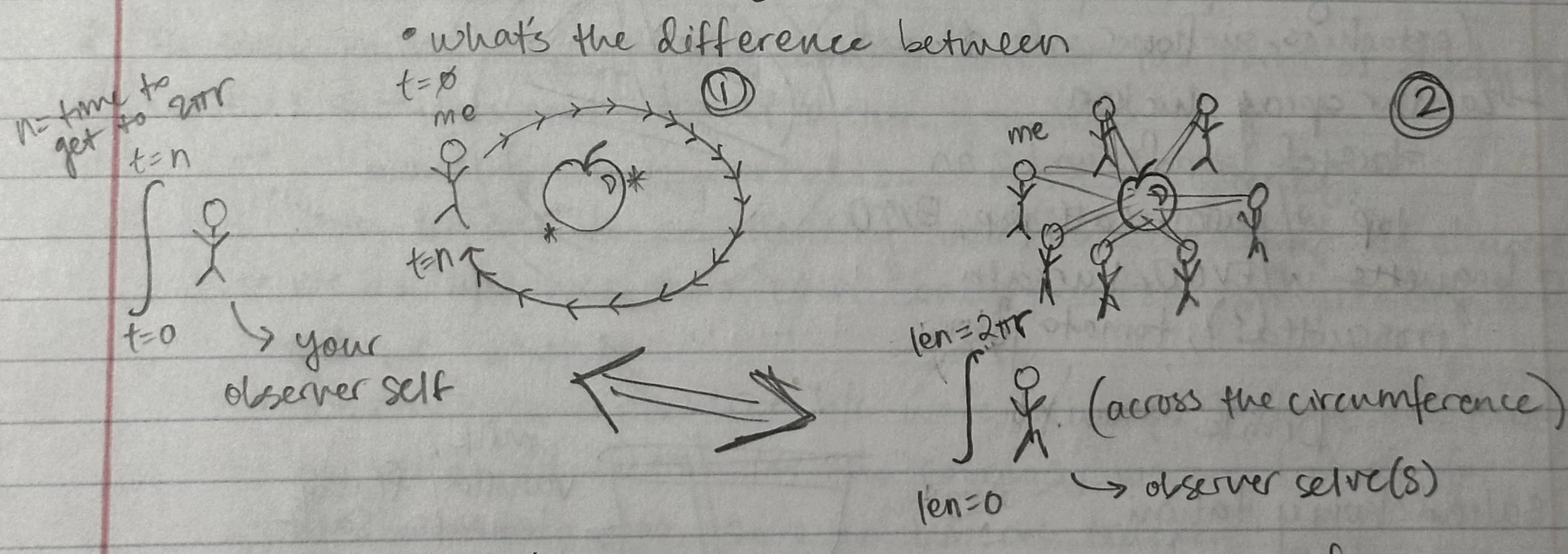
If we take an example of an apple, you see in 2D but perceive in 3D due to light and shadow allowing interpretation of something having 3 spatial dimensions. But if you wanted to know for sure, you’d have to make a 360 round around that apple from time t = 0, till time t = n, where n indicates how long it takes to complete a full circle.
As a sole agent, you will need to do all the traveling with time to capture every vantage point of what makes that apple 3D. What if we turn this around?
What if, instead of n points of time, we have n number of people? So n people all circling around the apple looking at all of the dimensions at once? So as sole agents, we aren’t aware of other points of space, but we are aware of points of time AS we experience them and we are aware of past, present, and future simultaneously as a concept. Space is really proven when other agents are also perceiving from that space, otherwise it’s just a concept.
Now, by having n people, we are aware of the concept of space. Both scenarios allow for one thing: seeing multiple dimensions of that apple. Having a full experience of that apple.
Single observer: information accumulates over time.
Multiple observers: information accumulates in parallel.
Both lead to the same knowledge of the object. Many observers allow a faster reconstruction of reality.
The reality of multiple dimensions (vantage points) of an object may exist independently, but knowledge of reality depends on perspective (participation).
Our Search for the Nature of Reality
Let’s be honest about why we study cosmology, astronomy, and astrophysics. As kids, we are starry-eyed, just like the cosmos as children are typically closest to divine consciousness, thinking all of this science is purely for the love of the game.
A lot of this at a global, systemic level is possible by funding. Funding is what gives experimental apparatus, funding is what allows for trials, having laboratories, hiring employees, pushing knowledge into the media, interdisciplinary collaboration for updating the advancement of society, etc. We don’t ask enough questions about funding.
What is the goal that the funders have for studying cosmology, astronomy, and astrophysics might be a better question to ask.
The love of the game catalyzes curiosity to learn, funding accelerates and expands this game, but funding also limits it. Funding, in the context of monetary wealth, is not self-sourced, it is external. External agents have agendas, too. Here is where discernment is instrumental. Funding exists so long as external agent(s) have benefits with this expansion.
I’ll let you guys think about what it looks like when expansion of knowledge goes too far and why we might be stuck in cycles of literal thinking and processing ;)
Can science be okay with not measuring things perfectly all the time? Once again, we have to ask, what is the need to do that? Because then it gets into the philosophical question of what proof is. So currently, proof is everything that's understood through the left side of the brain. What about experiential proof? Experience is data, too.
For example, the one time I tried LSD and I encountered entities and spirits telling me the truth of my destiny, secrets of the universe, I knew with 110% certainty what they were telling me was the truth, but it wasn't just logical. It was something I could feel in every atom of my body, in my brain, the mind, the psyche, the physical body, the soul, all of it. We must continue to question the concept and methodology of knowing itself. As material reality gets more intellectualized and understood, we make room for perceiving more of the etheric realm, as we are all affected by it, but we find our current scientific method has limitations, don’t we? That's not to say that there aren't structures and patterns in the etheric realm, but at the same time, there will be completely different avenues of execution.
By virtue of this argument, I find myself suggesting a meritocracy in the “proof” of consciousness being fundamental: the people that will understand what I'm talking about are not going to be the people who have logical proof solely in the left side of the brain, but the ones that have full architecture knowing. They will experience (via brain, body, and consciousness/soul) and embody consciousness as fundamental and that is the proof. Right now, modern scientific/mathematical proof is “knowing” truth in the left side of the brain. My suggestion of proof is non-linear, fundamental, ubiquitous, this would require every aspect of you embodying that truth, meaning your whole being will be communicating this knowledge via embodied presence, as opposed to just left-brained knowing which would be communicating via external verbal speech.
Science tries to remove the observer, but who is science trying to prove itself to? If you want to create proof, the nature of proof is desiring validation, right? And validation comes from what? Observers.
Coming back to the apple and observer(s) example:
being conceptually aware of multiple dimensions of an object is knowing in the mind
we know there’s multiple vantage points right now because multiple observers told us
being embodied awareness is knowing of mind/body/consciousness (soul)
we only experience multiple dimensions of the apple as we travel with and through time as sole agents
Though we’re working with a simple, human example with the above scenario, we can posit a clear difference between conceptually knowing of reality and participating directly in reality, which demonstrates knowledge via immersion and embodiment.
Reviewing the differences: conceptual knowing occurs when we localize consciousness to just the brain, embodied knowing occurs when consciousness expands beyond cognition and feels like an experience that can’t fully be logically explained
That. That is exactly why i say consciousness is fundamental.